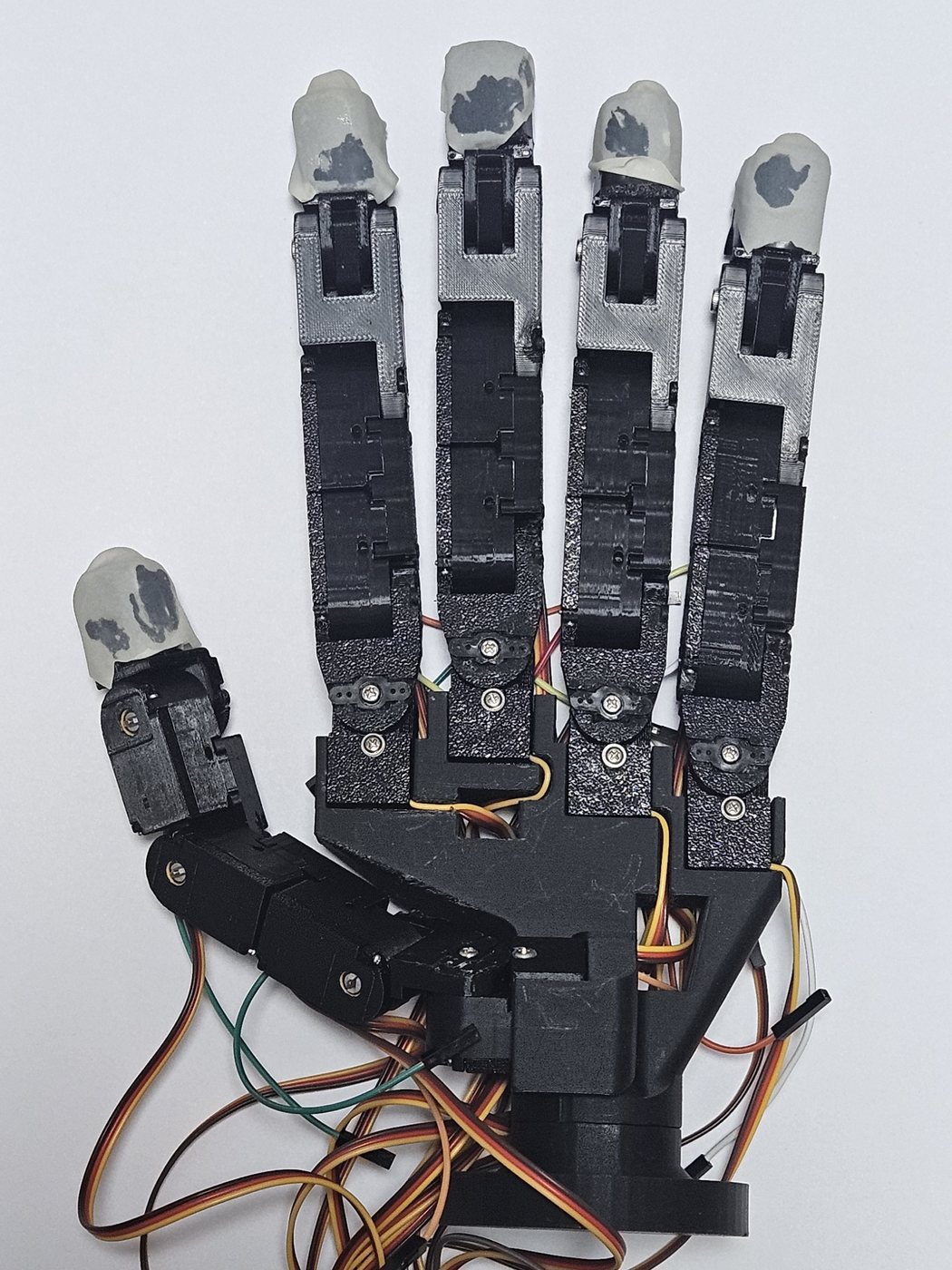
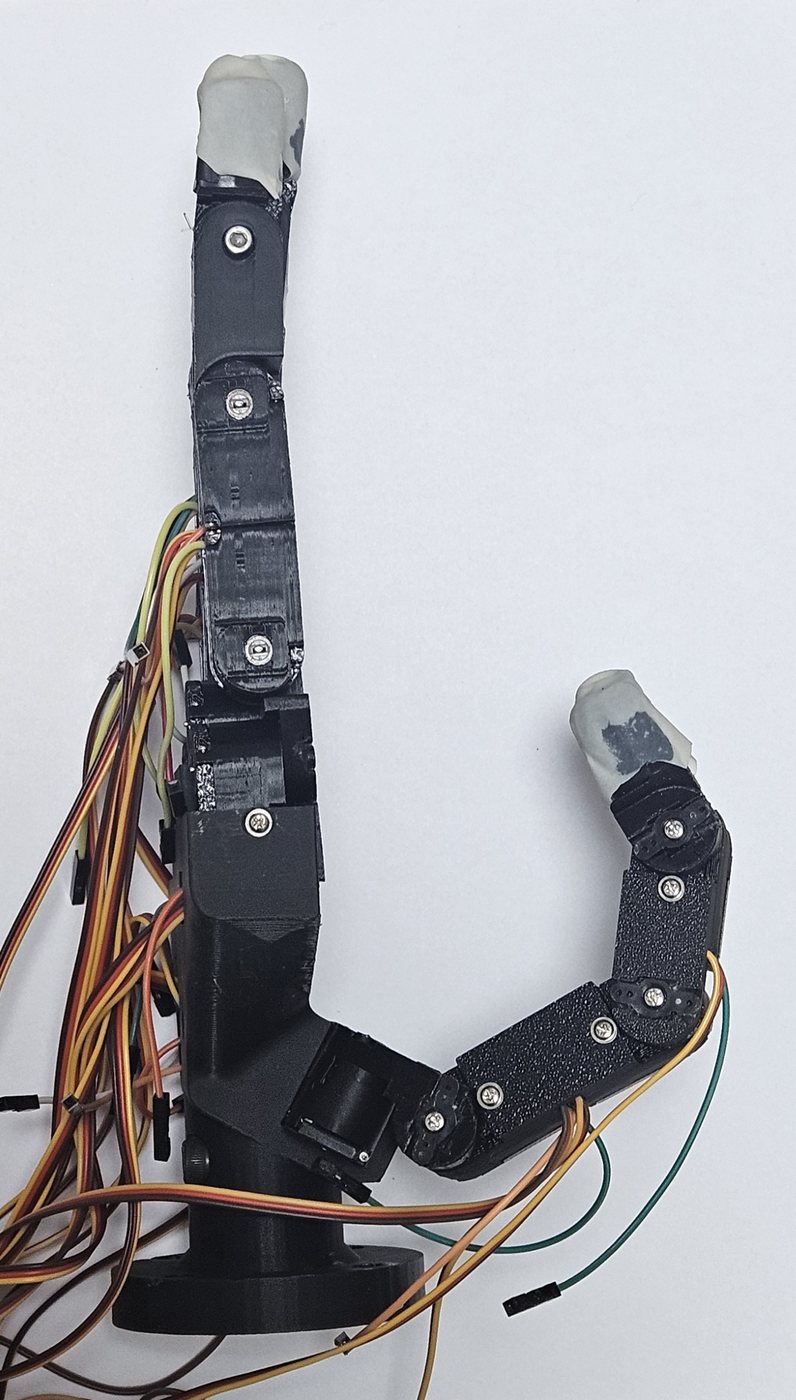
Handling Hand:

A Low-Cost Modular 16-DoF Robotic Hand
with Servos Rearranged Inside the Fingers

보급형 모듈화 다자유도 로봇손

Jeonghwan Park Taehwan Yoon Seunghwan Um Hyouk Ryeol Choi†
School of Mechanical Engineering, Sungkyunkwan University (SKKU)
16th KSME National Student Design Competition, 2026
Team Handling (핸들링)  ·  †Faculty advisor

Abstract

Dexterous multi-fingered hands are in growing demand for humanoid, service and robot-learning research, yet commercial hands such as the Allegro and Shadow hands rely on dedicated actuators or tendon transmissions and cost from tens of millions to over a hundred million won, while recent 3D-printed tendon-driven hands such as RUKA and ORCA still cost millions of won and inherit the assembly and tensioning burden of tendon drives. We present Handling Hand, a modular 16-DoF robotic hand of human-hand size (about 20 cm tall) built only from commercial MG90S hobby servos and 3D-printed PLA+ parts. Each servo is taken out of its housing, and its motor, gear train, potentiometer and control board are rearranged inside a finger-shaped frame, so the actuators sit directly in the fingers while keeping the servo's own position control. In the index-to-little fingers, the DIP joint is coupled to the PIP joint by a rigid link whose nonlinear angle relation we derive from the link geometry; an elastic-cord passive fingertip compensates for the fixed coupling, and the thumb gets an independently actuated DIP joint. The four fingers use one identical module design, and each detaches from the palm on its own, so repairs can be made at the finger or servo level. A MuJoCo grasp simulation checked the design before the final hand was built, and the hand is driven by an ESP32 and a PCA9685 servo driver. The prototype performs enveloping and fingertip grasps on objects of different sizes and, mounted on a collaborative arm, multi-step tasks such as unscrewing a light bulb and wiping a whiteboard, at a parts cost of 87,340 KRW: less than 1% of the price of commercial multi-DoF hands.

16
actuated DoF
(thumb 4 + 4 × 3)
₩87,340
total parts cost
(< 1% of commercial hands)
~20 cm
tall, adult-hand size
5 fingers
MG90S
16 hobby servos, rebuilt
inside the fingers

In most demonstrations the hand is mounted on a 6-axis collaborative robot arm. Clips are muted and sped up where marked; uncut videos are at the bottom of the page.

Unscrewing a Light Bulb

The hand closes around a lit bulb, and the lamp goes dark as the twist breaks the contact. It unscrews the bulb with repeated grasp–twist–release cycles; when the bulb comes free it drops onto the table, and the hand reaches behind the socket to pick it back up.

1.5×

Twisting a lit bulb until the lamp goes dark

3×

Fingertip grasp, wrist turn, release, repeat

2×

Recovery: the freed bulb fell behind the socket; the hand pinches it and lifts it

8×

Take 2 in full, about two minutes: the lamp goes dark, regrasp cycles, the bulb comes free and drops, then it is picked up

Pick, Open, Drop, Close

A long-horizon task with a soft object: an enveloping grasp of a plush toy, pushing a bin lid open while still holding it, a quick release into the bin, and pushing the lid shut with the fingertips.

3×

Grasp the plush, press the spring lid open, drop it in

3×

The plush deforms in the grasp; the fingertips push the lid open

2×

Release into the bin, then close the lid with the fingertips

Tool Use: Tissue and Eraser

A thumb–finger pinch pulls a single tissue out of a dispenser and lays it on a whiteboard; the hand then picks up an eraser and scrubs the marker off through the tissue.

4×

Pinching a tissue from a pop-up box and draping it on the board

3×

Thumb-versus-fingers grasp of a whiteboard eraser

3×

Re-grasp and wipe: the tissue drags across the board

Fingertip Pinch of a Thin Object

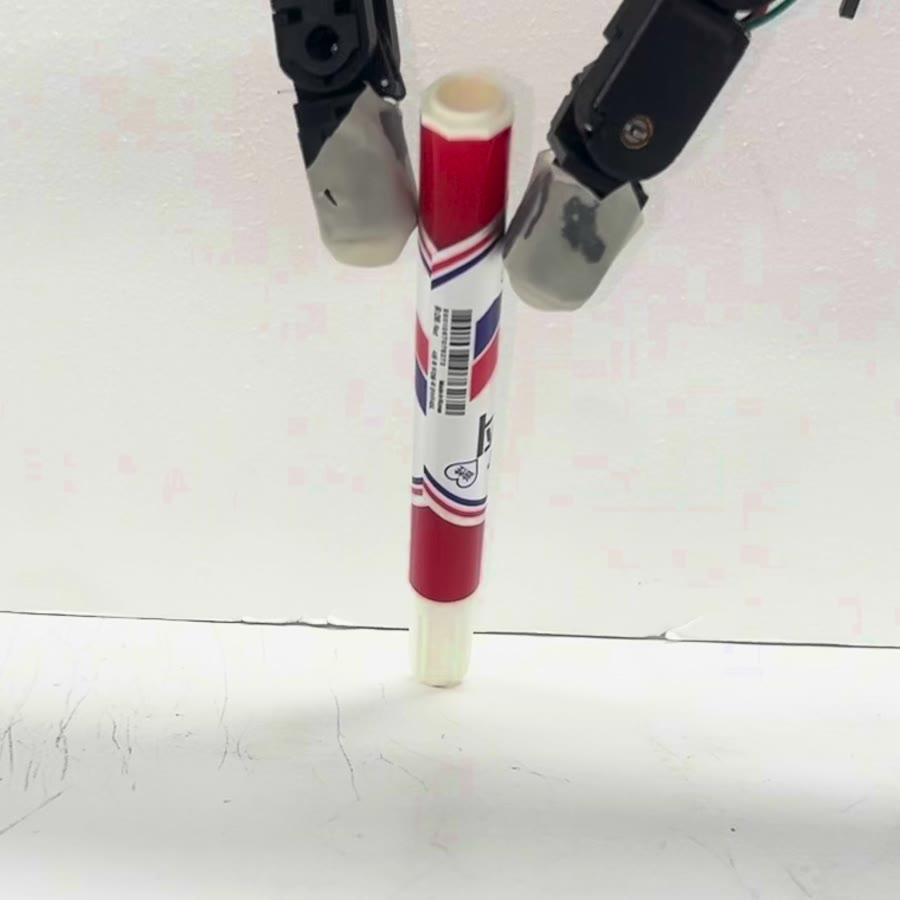
With the other fingers held straight, one finger and the thumb reach the table on either side of a marker lying flat, center it and pinch it. On lift-off the marker pivots 90° between the fingertip caps and stays pinched as the hand lifts it off the table.

2.5×

Approach and pinch a marker lying flat on the table

1×

Nudging and centering the marker between the fingertips

1.5×

The marker pivots 90° in the pinch, then is lifted off the table

Design: A Servo Rebuilt Inside the Finger

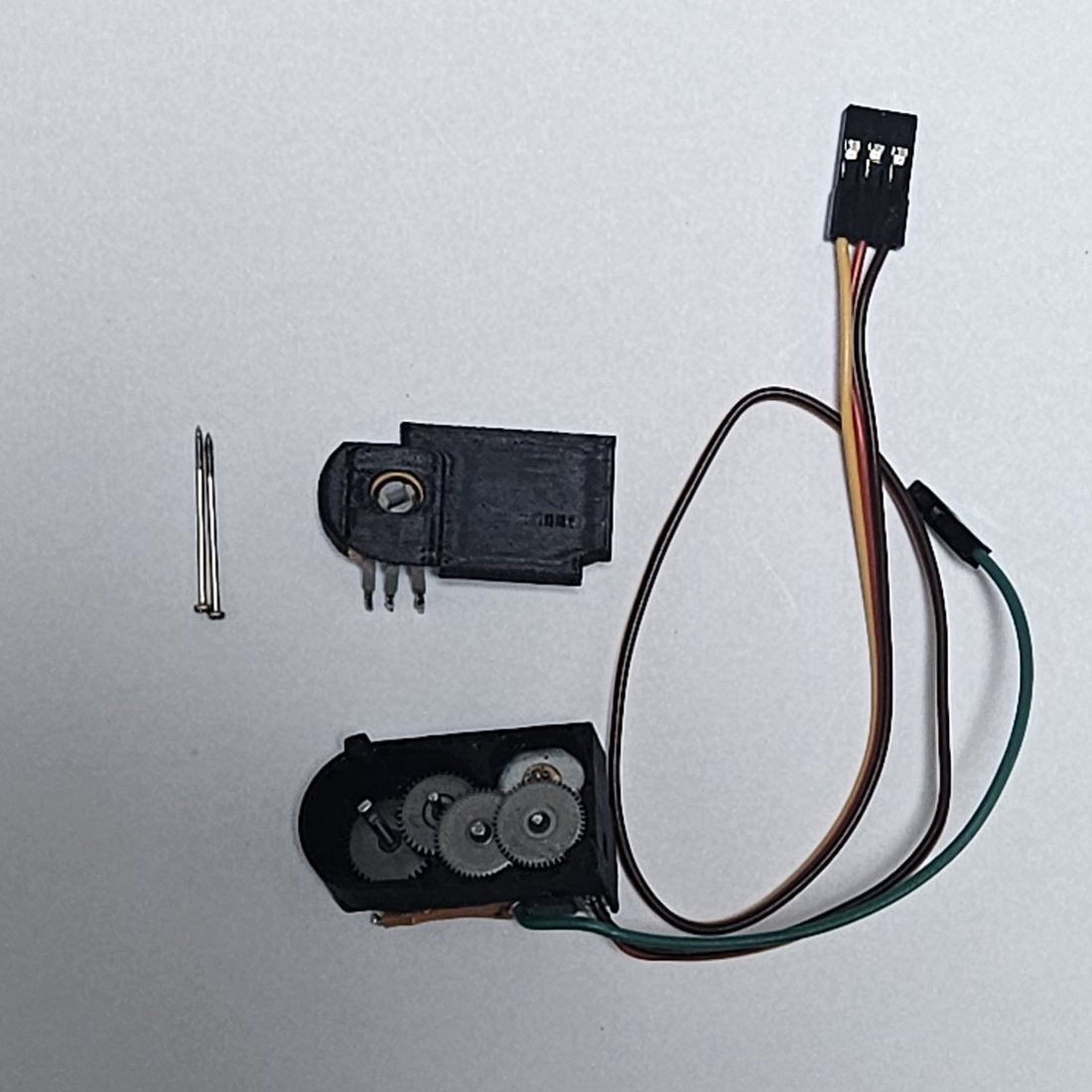
A stock MG90S micro servo is a DC motor, a multi-stage reduction gear train, a potentiometer and a control board inside a boxy housing that does not fit a human-sized finger. We discard the housing and relocate the motor and gears along the length of the finger, keeping the original gear meshing and reduction, in a 3D-printed frame sized to the finger's width and thickness. The frame doubles as the phalanx and supports the actuator, each joint is actuated in place without tendons, and the unit is still commanded with a target angle like an unmodified servo.
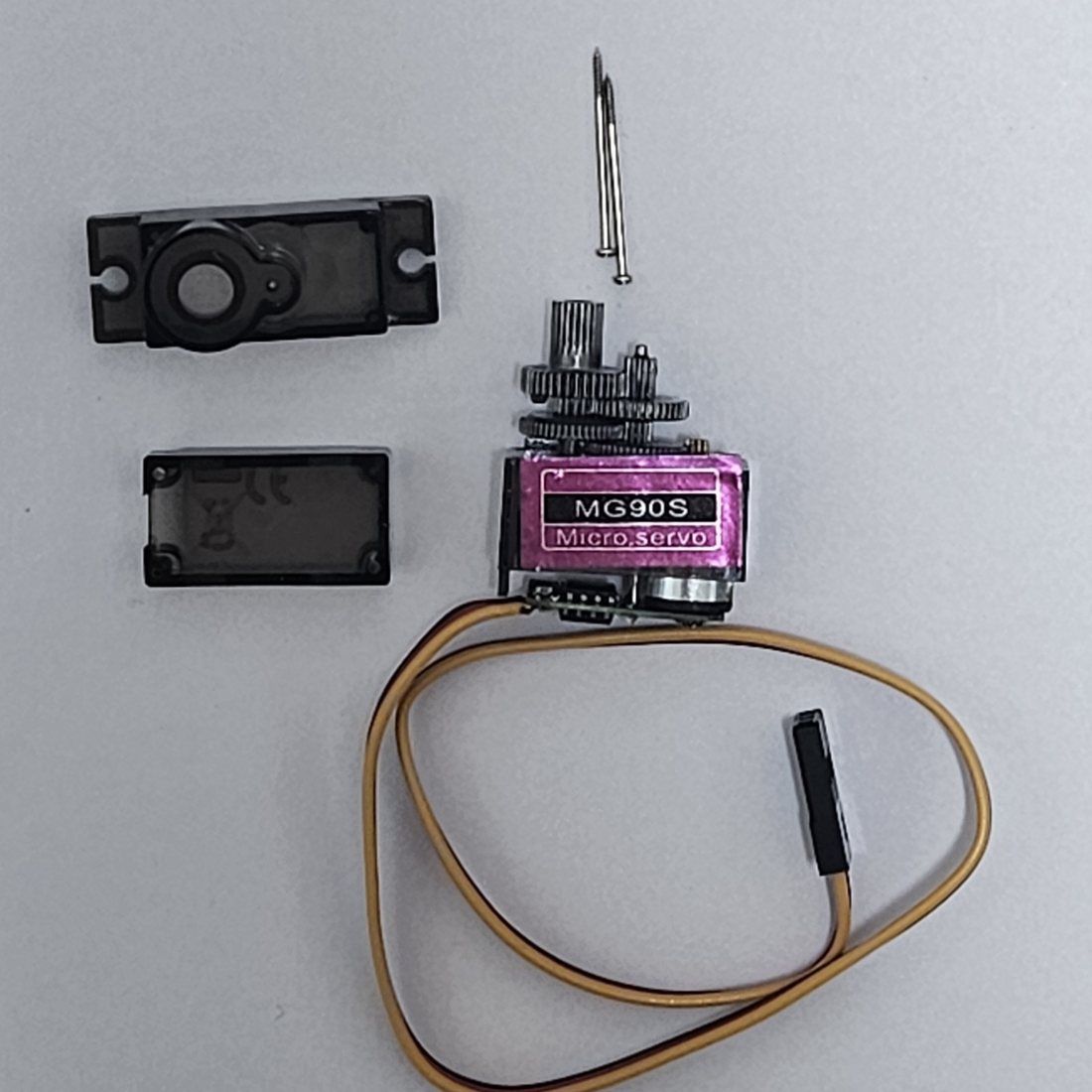
A stock MG90S micro servo taken apart

(a) Stock MG90S, disassembled

The same servo parts rearranged into a finger-shaped printed frame

(b) Rearranged into a finger-shaped frame
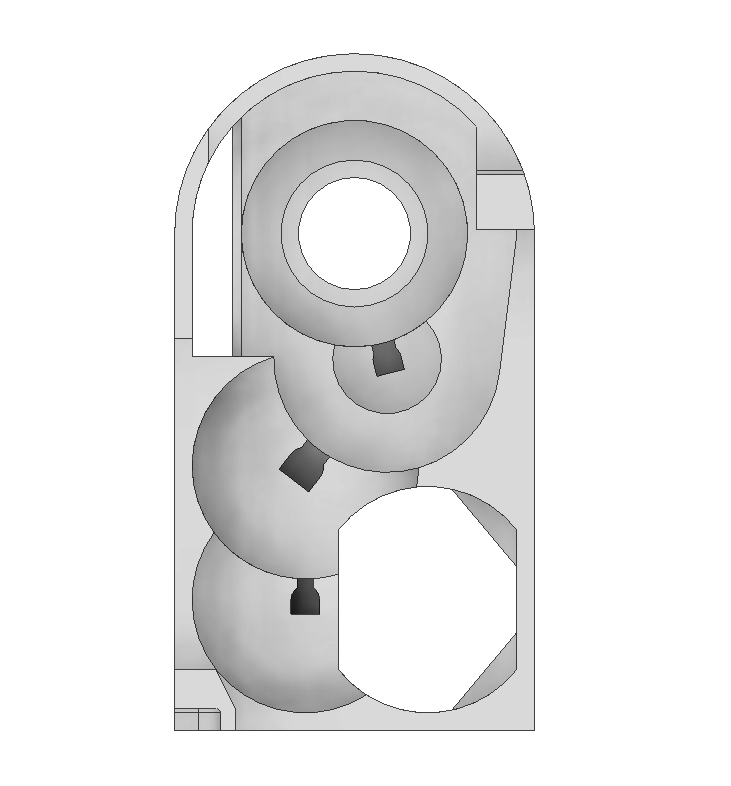
CAD of the gear train laid out inside the redesigned frame

(c) Gear train laid out along the redesigned frame (CAD)
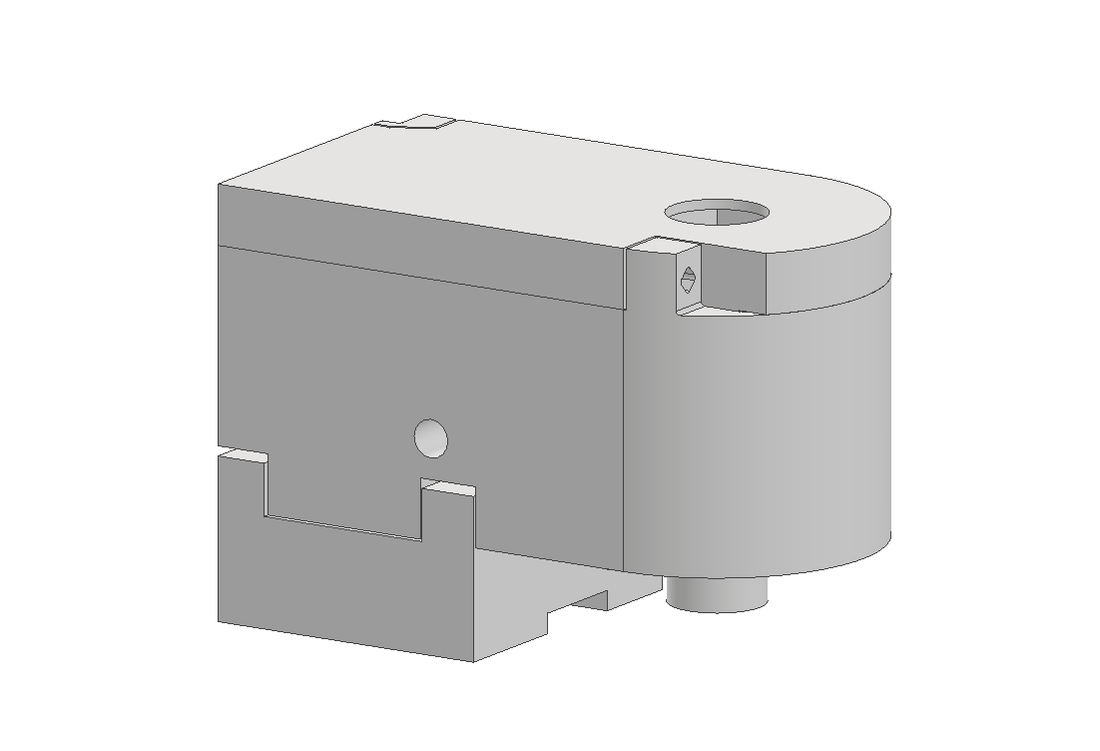
CAD of the closed frame

(d) The frame, closed (CAD)

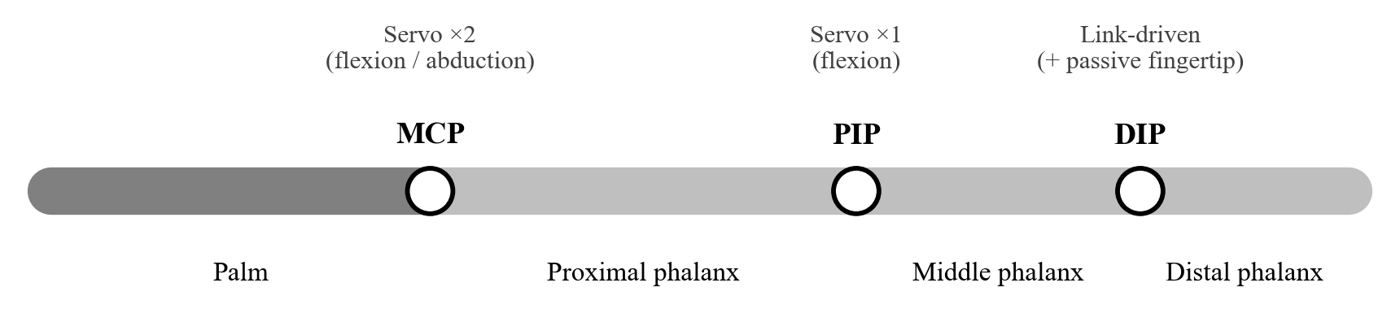
Diagram of one finger: two servos at the MCP joint, one servo at the PIP joint, and a link-driven DIP joint with a passive fingertip

Joints of one finger and how each is driven

Stock servo as-isTendon driveRearranged servo (ours)
CostLowMediumLow
Control difficultyLowHighLow
Space efficiencyLowHighHigh
Fabrication difficultyLowHighMedium
MaintainabilityHighMediumHigh
Actuator inside the fingerHardNot neededPossible

Each index-to-little finger has three servo units: MCP abduction, MCP flexion and PIP flexion. The DIP joint has no motor; it follows the PIP through a rigid link.

PIP–DIP Linkage

The DIP joint follows the PIP through a rigid link (L ≈ 30.38 mm) placed so that both joints agree at 0° and 90°. In between, the relation is deliberately nonlinear: early in flexion the DIP lags by up to about 2.5°, so the fingertip approaches the object fairly straight, and in mid-range it leads by up to about 6°, so the finger curls around the object. Drag across the plot or use the slider.

Geometry (mm, extended pose): P = (0, 0), A = (0, 9.86), D = (0, 30), B = (6.6, 39.514). φ(θ) solves |B(θ, φ) − A| = L; values from the team's computed table (data).
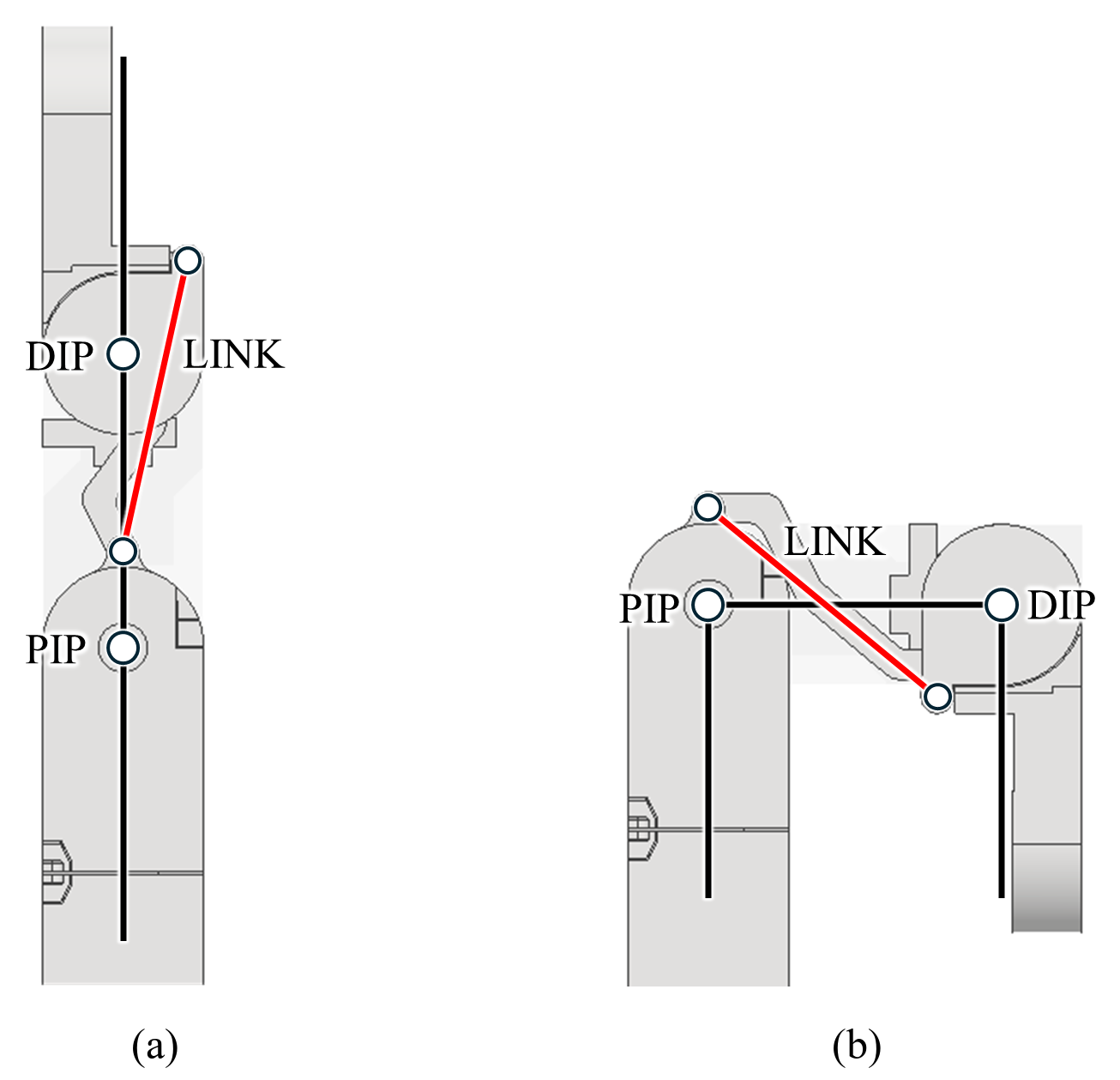
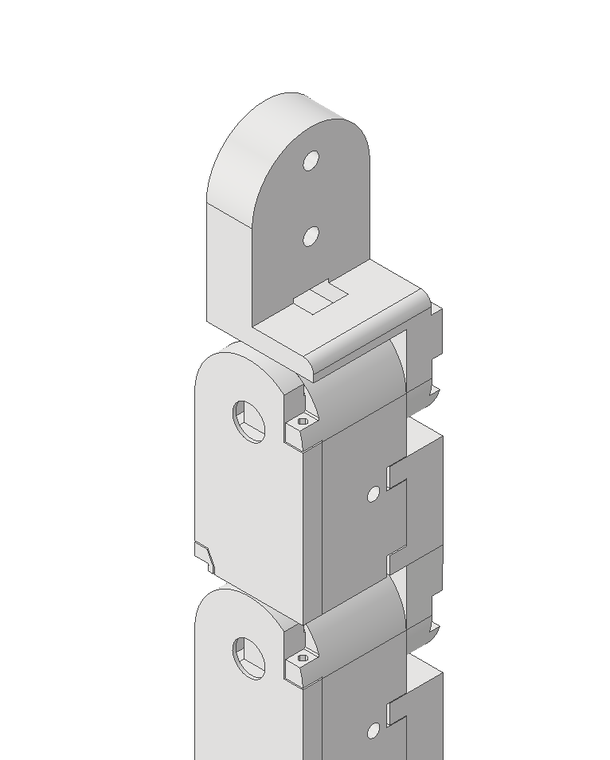
CAD side views of the PIP–DIP link, extended and flexed

The link in the CAD model: (a) extended, (b) flexed

Passive Fingertip and an Independent Thumb DIP

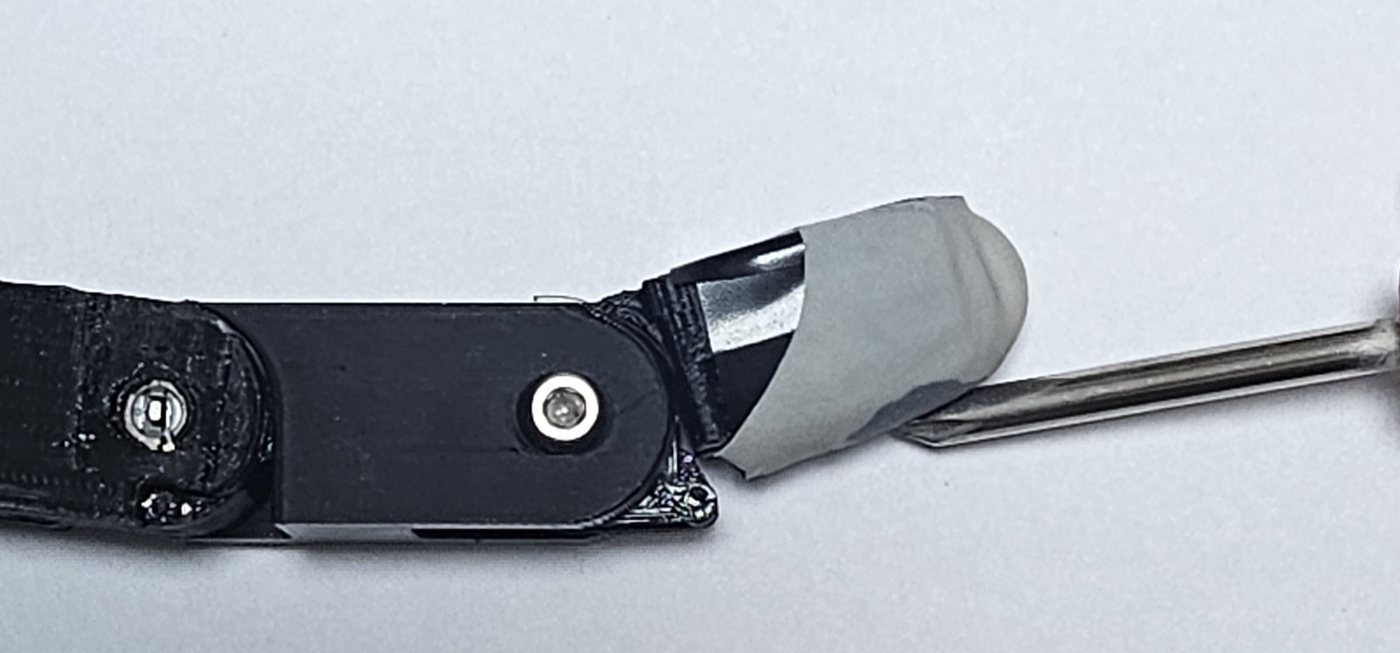
Because the linked DIP cannot adapt on its own, small objects touched near the tip could get poor contact. The fingertip is tied to the top of the DIP segment with an elastic cord: it holds its default pose, folds back under contact force, and springs back when released, with no extra actuator. The thumb instead gets its own DIP servo (4 DoF), which made the thumb grasp less awkward than in the first design.
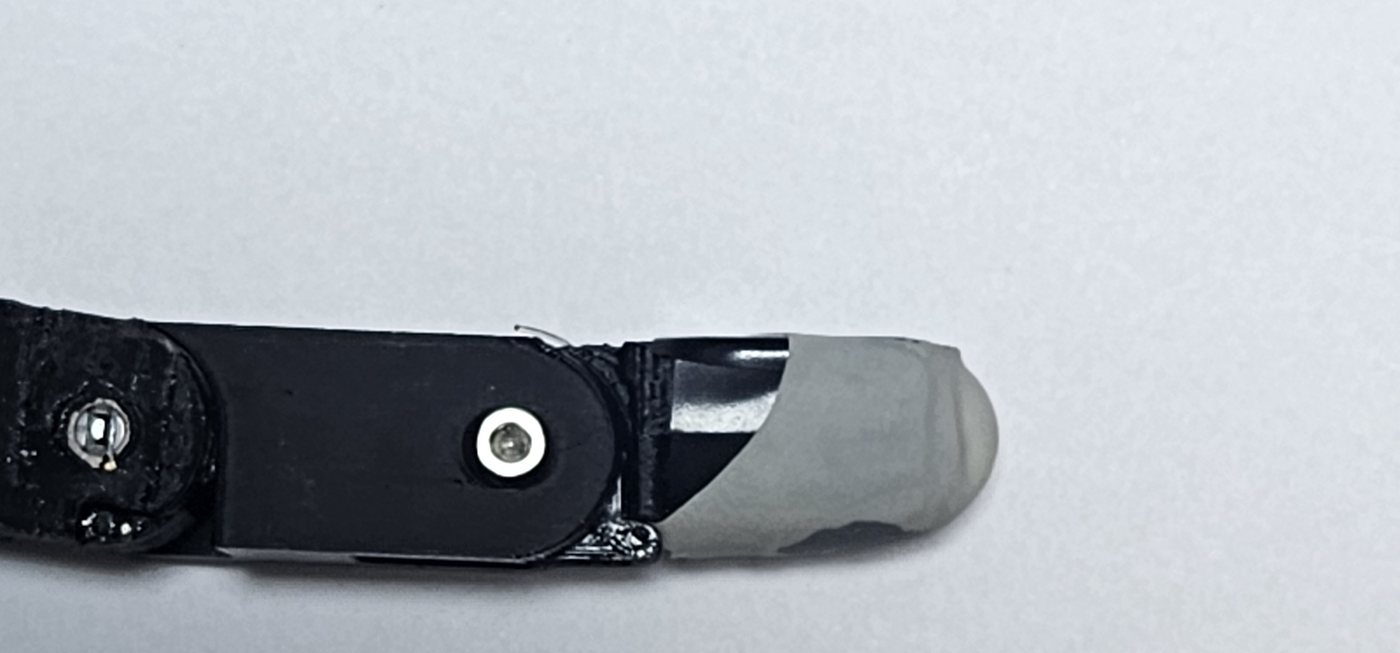
Fingertip at rest

(a) No external force

Fingertip deflected by a pushing tool

(b) The fingertip folds back under contact force
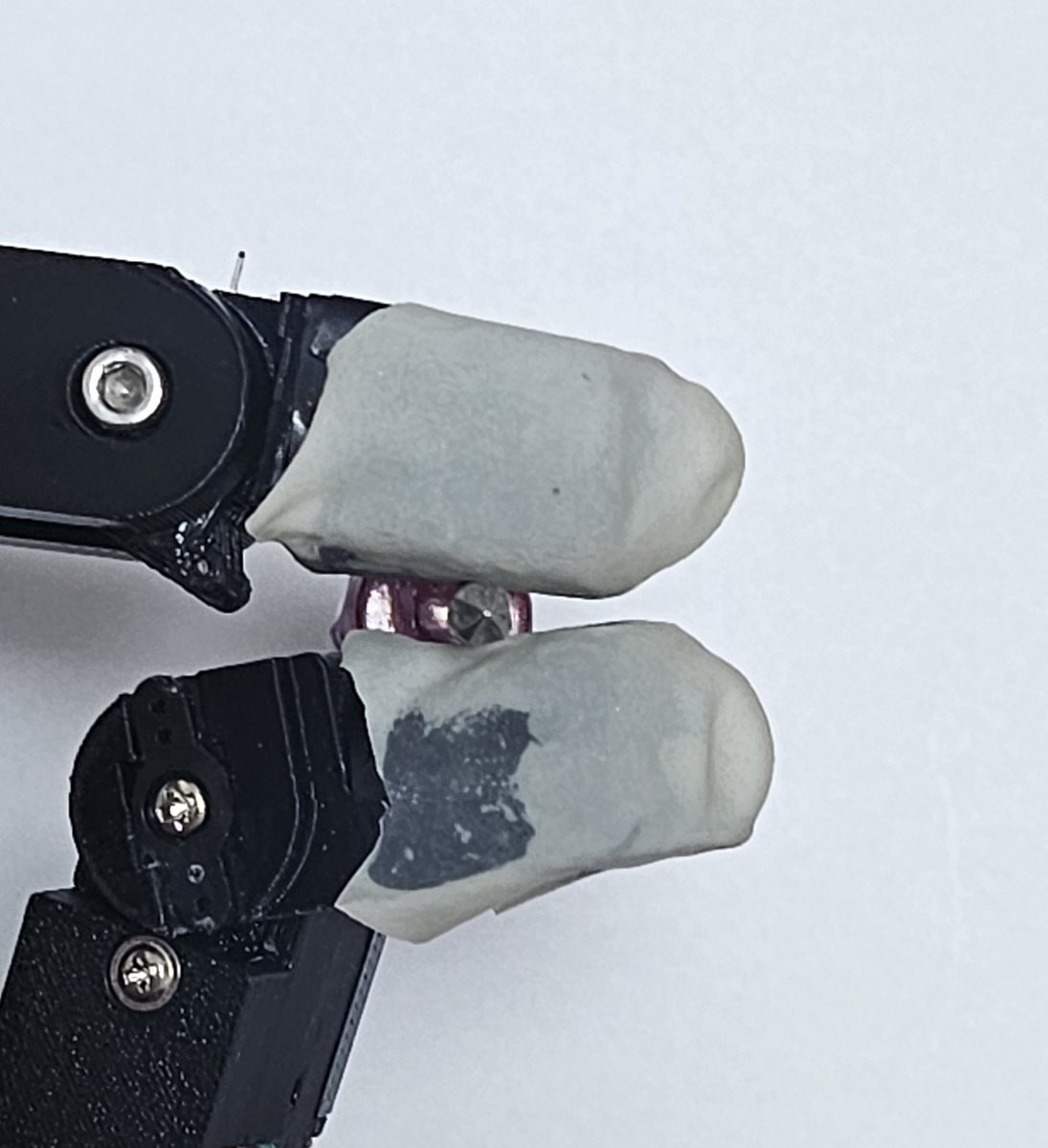
Index and thumb fingertips pinching a small screwdriver

(c) Fingertip grasp of a thin object

CAD of the thumb tip with an independently driven DIP

(d) Thumb: its own DIP servo

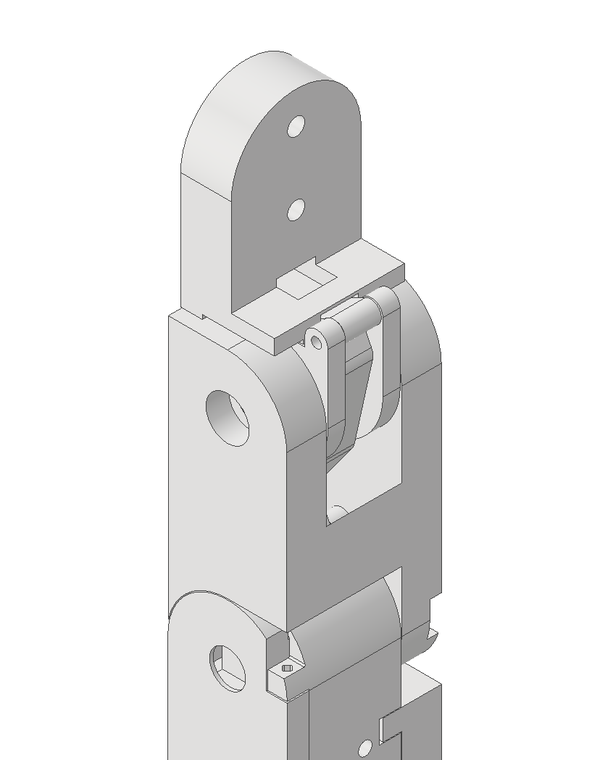
CAD of the index tip with the PIP–DIP link

(e) Index: linked DIP

16 DoF, Modular Fingers

The four fingers are identical modules (3 DoF plus the linked DIP) that detach individually from the palm and can swap positions; the thumb reuses the same lower (MCP) structure and differs only in its distal part. A damaged servo can be replaced inside its module without rebuilding the finger. Drag to rotate the model below.

Loading 3D model…
drag to rotate · scroll to zoom
Joint sliders
DigitActuated jointsDoF
ThumbMCP flexion, MCP abduction, PIP, DIP4
IndexMCP flexion, MCP abduction, PIP (+ linked DIP)3
MiddleMCP flexion, MCP abduction, PIP (+ linked DIP)3
RingMCP flexion, MCP abduction, PIP (+ linked DIP)3
LittleMCP flexion, MCP abduction, PIP (+ linked DIP)3
Total16 servos + 4 passive linked DIP joints16

PIP flexes 0–90° and the linked DIP follows over 0–90°. The MCP flexion and abduction ranges have not been measured yet.
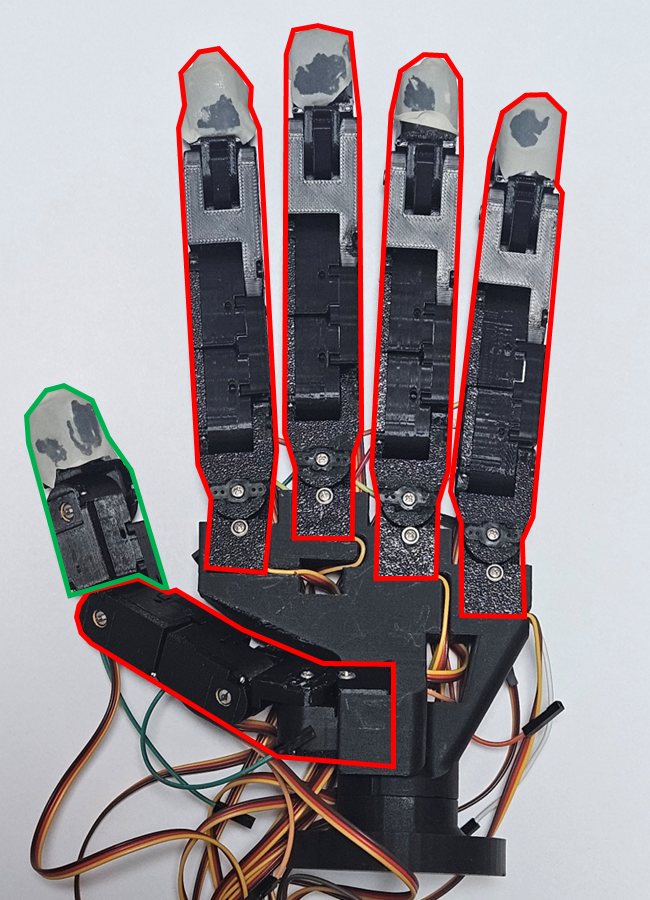
Photo with the common finger structures outlined in red and the thumb-specific DIP part in green

■ common structure, ■ thumb-specific DIP part
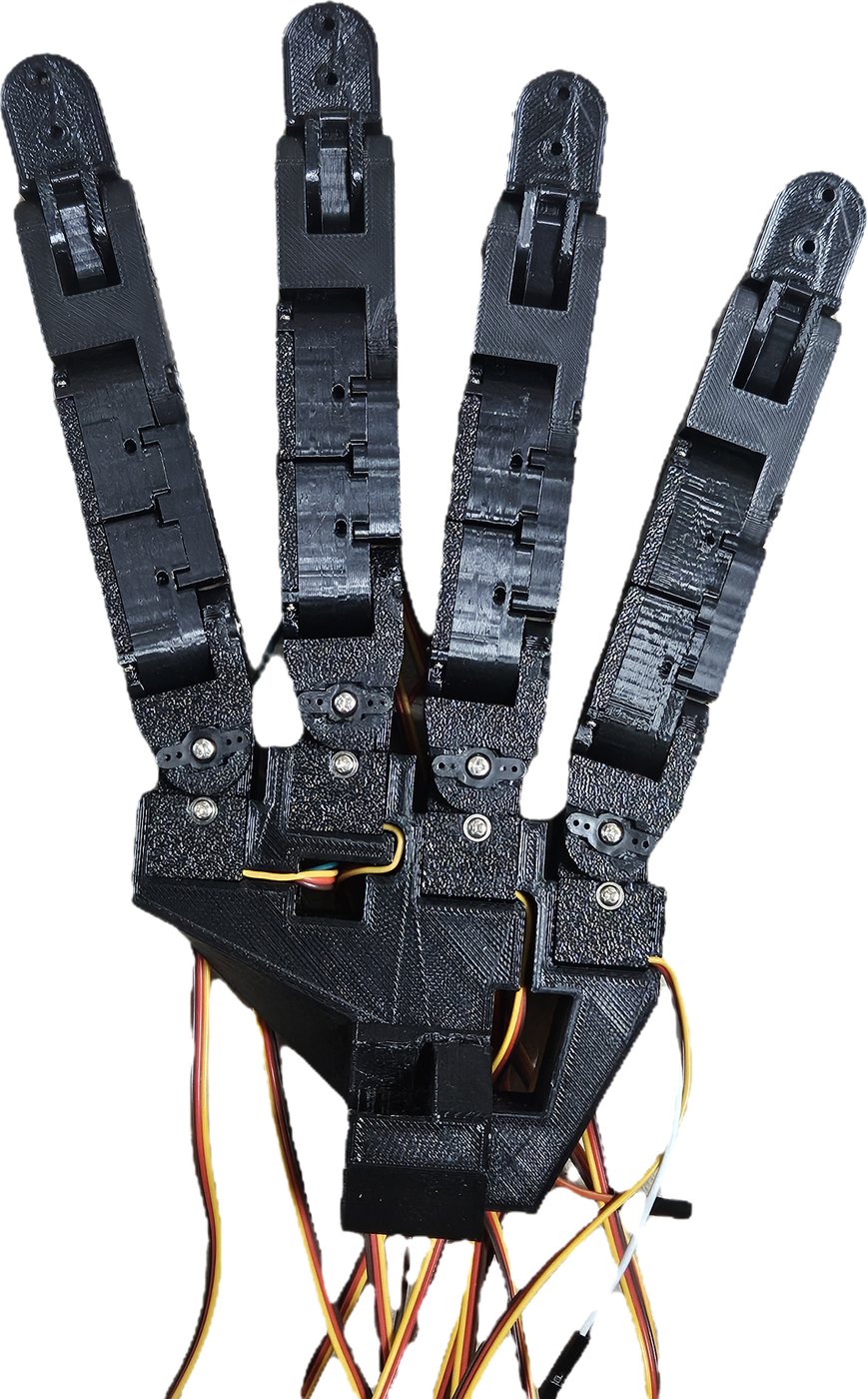
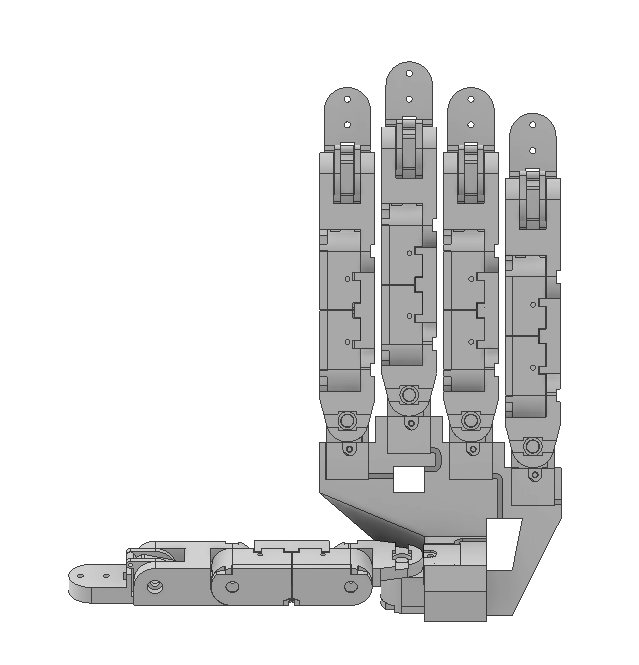
Palm with the four identical finger modules and the thumb removed

Four identical modules mounted, thumb detached

Control and Electronics

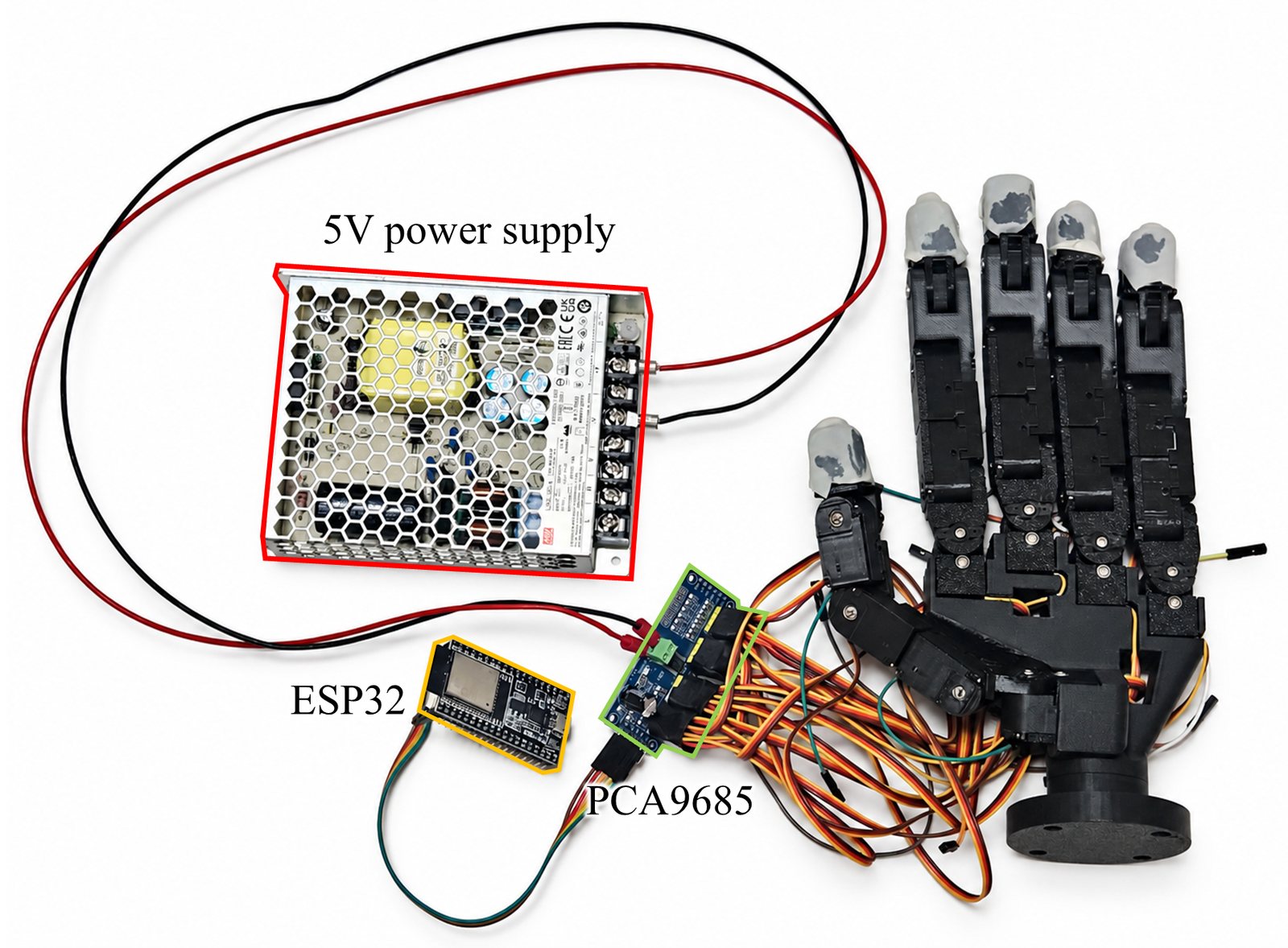
A PC sends joint targets over USB serial to an ESP32, which drives a PCA9685 16-channel PWM board over I²C, one channel per actuated joint. Each rebuilt servo closes its own position loop with its original potentiometer, so no external joint sensors are needed. Servo power comes from a separate 5 V supply wired to the PCA9685 V+ terminal, so current spikes do not disturb the logic.
PCmotion command
USB serial
ESP32MCU
I²C
PCA968516-ch PWM driver
PWM × 16
16 rebuilt servosrobot hand
5 V supplyservo power (V+), separate from logic
Wiring of the ESP32, PCA9685 and 5 V power supply to the hand

The complete system: 5 V supply, ESP32, PCA9685 and the hand

Grasping Objects of Different Sizes

Each grasp follows three steps: MCP abduction sets the finger spacing and the thumb moves into opposition; MCP and PIP flex, and the linked DIP curls each finger around the object; on contact the passive fingertips comply while the thumb DIP presses from the opposite side. Spreading the fingers lets the hand wrap a large object, medium objects are grasped without spreading, and thin objects are held at the fingertips.
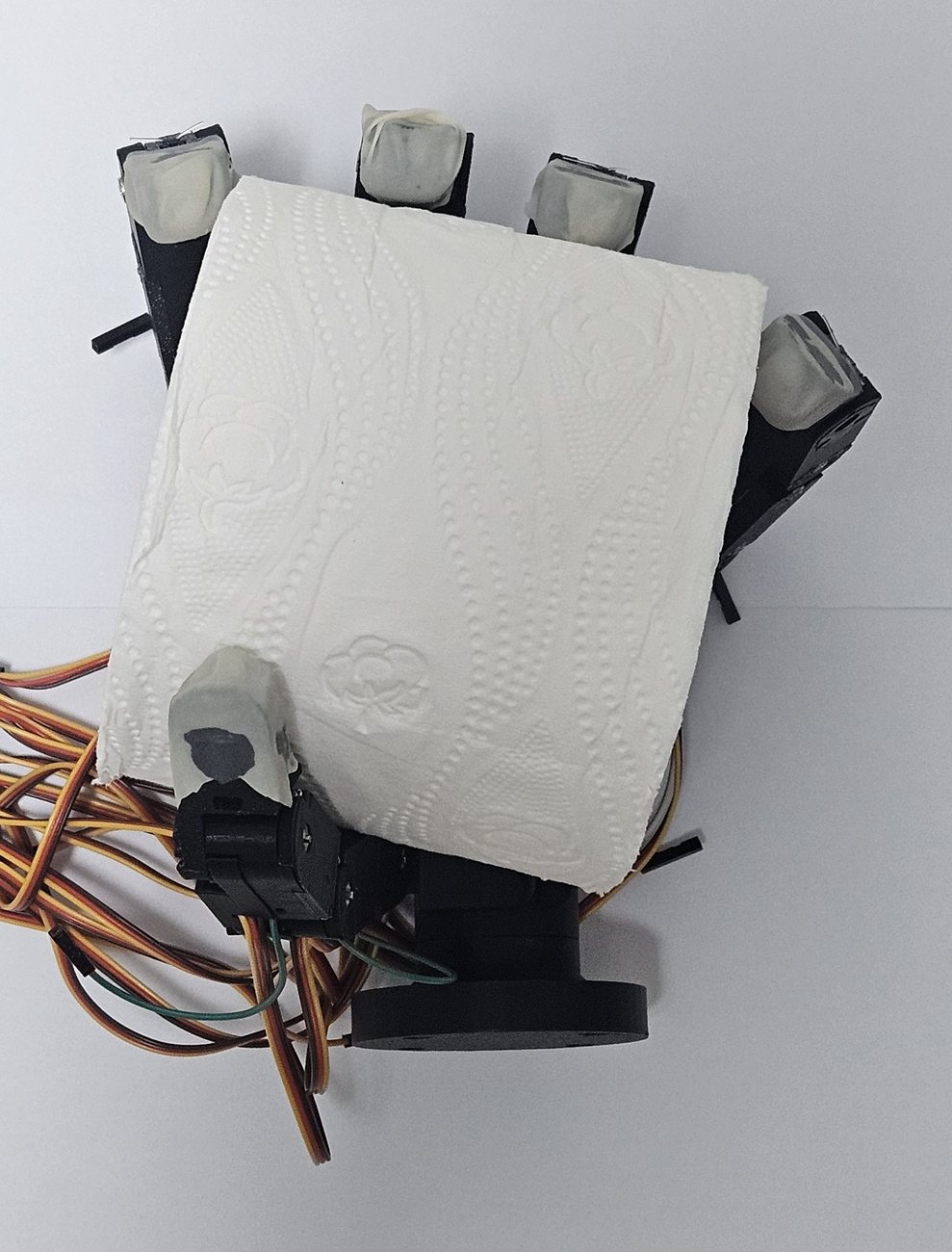
The hand wrapping a large paper-towel roll with fingers spread

(a) Large object, fingers spread by MCP abduction
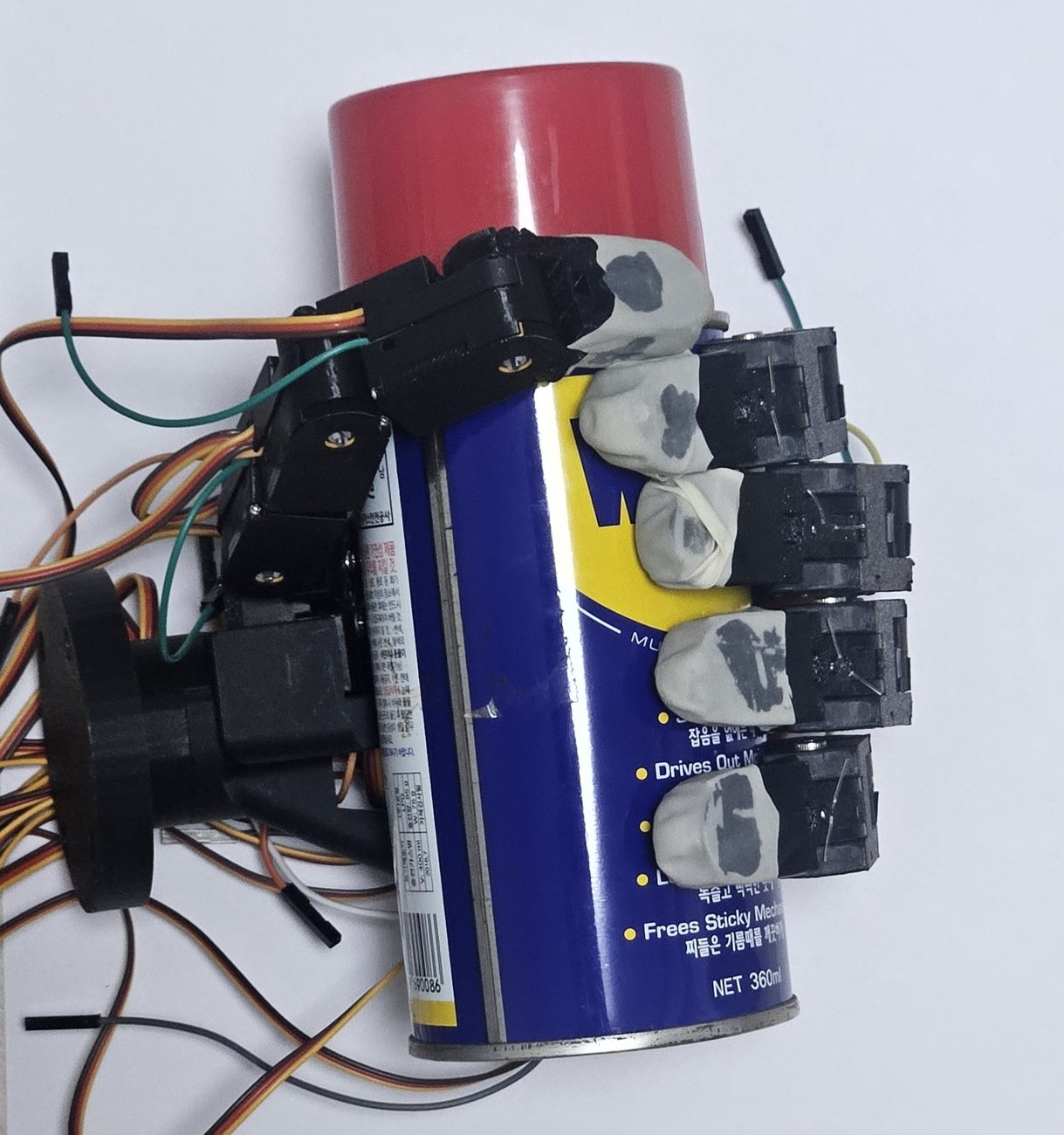
The hand gripping a spray can

(b) Medium object, no spreading

A marker held upright between two fingertips

(c) Thin object (a marker) held at the fingertips
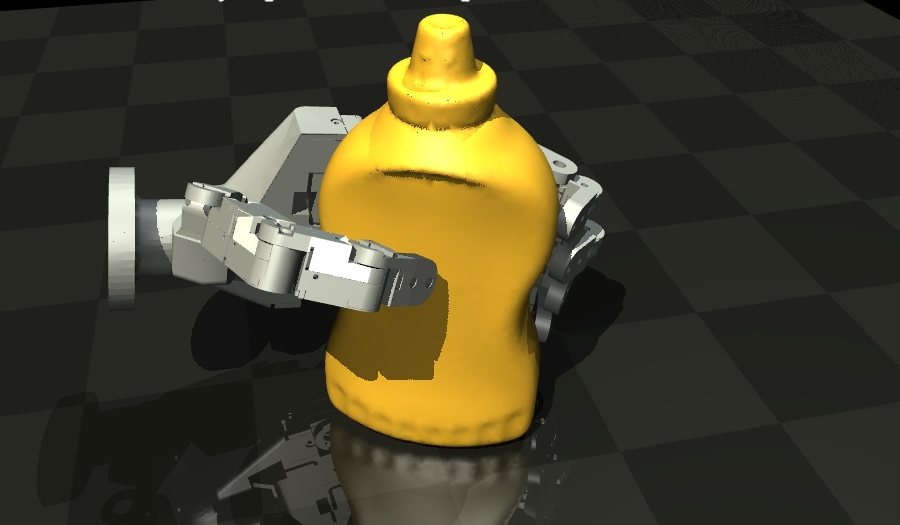
Simulation

The Inventor assembly was exported to URDF and MJCF and tested in MuJoCo before the final hand was built. Closing the hand quasi-statically around a YCB mustard bottle, the four fingers wrap one side, the thumb opposes and the palm supports the bottle. The forces below are simulated contact forces, not measured grip force.

MuJoCo render of the hand grasping a yellow mustard bottle

MuJoCo grasp of the YCB mustard bottle

Contact normal force during a quasi-static close sweep (MuJoCo)

Each point settled for 1 s in simulation; peak total 32.7 N. The run used the earlier simulation model, in which the finger DIP joints were commanded separately rather than through the linkage. One failed step (close = 0.36, where the fingers did not close) is not plotted. Hover or tap for values. Data (CSV)

Cost

The whole hand costs 87,340 KRW in parts, with the 16 servos about 38% of it. Because every actuator is an off-the-shelf hobby servo, a broken joint is fixed by swapping a servo that costs a few thousand won. See the full parts list.

ItemQtyCost (KRW)
MG90S metal-gear micro servo1633,440
eSUN PLA+ filament, 1 kg119,800
5 V 18 A SMPS116,800
ESP32 dev board17,000
Wiring and consumables15,000
PCA9685 16-ch PWM driver13,300
M3 bolts and nuts12,000
Total87,340
HandActuationDoFPriceRepair
Shadow HandForearm motors + tendons20 act. / 24 joints≥ 100M KRW (US$100k+)Manufacturer service
Allegro HandDedicated DC motors in the fingers16 (4 fingers)≈ 20M KRW (US$15k+)Manufacturer service
RUKA / ORCA3D-printed, tendon-driven15–17≈ 2–4M KRW (build)User-built, open source
LEAP HandOff-the-shelf Dynamixel servos16 (4 fingers)< US$2,000User-built, off-the-shelf servos
Handling HandRearranged geared hobby servos, mounted at the actuated joints inside the fingers16 (5 fingers)87,340 KRW (parts)Swap a finger module or a single servo

Prices are approximate. Allegro, Shadow and RUKA/ORCA are from the KSME report (Tables 1 and 6), our hand from the itemised parts list (Table 5; Table 6 of the report PDF misprints it as about 130,000 KRW), and LEAP from leaphand.com.

Design comparison on six indices (1 = low, 5 = high)

Qualitative scores defined by the team from public specifications and each design's actuation method; hover or tap an axis for values.

Show as a table
OursAllegroShadowRUKA / ORCA
Low cost51.513
Module replaceability4.53.523
User maintainability4.52.51.52.5
Human-hand size4344
Number of DoF4454
Ease of control4433

From Mid-Term Design to Final Hand

In the mid-term report (July 2026) the thumb used the same linked DIP as the other fingers. Simulation and prototype tests showed that this limited the thumb-tip posture, so the final hand gives the thumb its own DIP servo. Passive elastic fingertips were also added to improve fingertip contact on small objects.

Mid-term CAD with a straight, link-driven thumb

Mid-term CAD (Jul 2026)

Final CAD with the thumb-specific DIP module

Final CAD

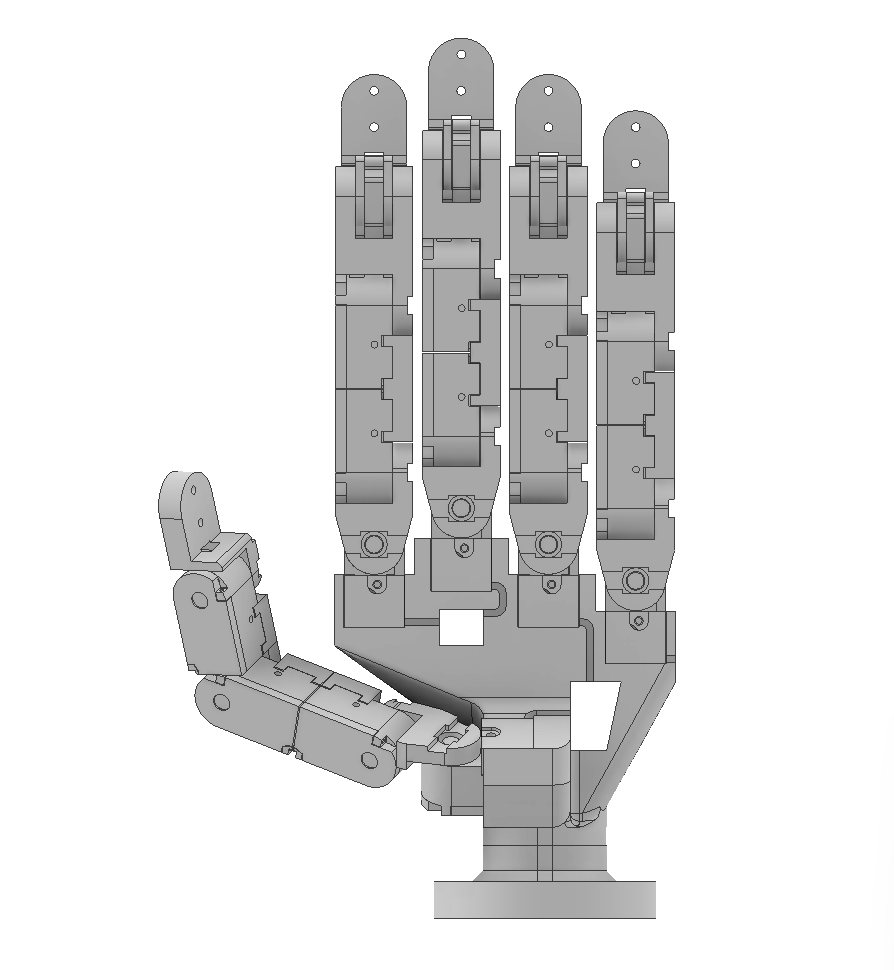
Final fabricated hand, front view

Final hand, front

Final fabricated hand, side view

Final hand, side

Design Problems and Fixes

ProblemCauseFixResult
No room for a servo inside the fingerThe stock servo housing does not fit the finger shapeRearrange the motor, gears and electronics to the finger shape and print a dedicated frameThe drive sits inside the finger
Driving the DIPAvoid an extra servo for the DIPCompute the link pivot positions and length from the PIP and DIP geometry before and after rotationThe DIP follows the PIP with no extra actuator
Joint play and print errorAdditive manufacturing gives dimensional error and frictionClearance-aware dimensions, post-processing and correction during assemblyJoints move without binding
Wear at joints and link connectionsThin sections at load paths, links and screw bossesThicker and reinforced load pathsNo breakage in repeated motion
Poor fingertip contact on small objectsThe linked DIP cannot set the fingertip posture on its ownElastic passive fingertip on top of the DIPThe fingertip adapts to the object with no extra actuator
Awkward thumb graspsToo few DoF at the thumb DIPA separate servo for the thumb DIPIndependent thumb-tip posture

From Table 4 of the report. The durability result is qualitative; no cycle count was recorded.

Limitations and Future Work

  • Grip force on heavy objects is limited by the torque of the small servos, and the PLA+ parts are less durable than the metal parts of commercial hands.
  • The DIP angle is fixed by the link geometry, so only the thumb has active fingertip posture.
  • Control is position-only, with no contact-force or joint-torque feedback, and grip force has not yet been measured on the hardware; the 32.7 N above is a simulation value.
  • Planned: a metal frame, fingertip contact and tactile sensors, and current-based force estimation for grasp-force control.
  • Intended uses: an education kit for kinematics, linkages and servo control; a low-cost hand for teleoperation and imitation-learning data collection with several units in parallel; and early end-effector prototypes for humanoid and service robots.

Uncut Videos

Every demonstration at real-time speed, without cuts (720p, muted).

Unscrewing a light bulb, take 2 (2:25)

Unscrewing a light bulb, take 1 (1:27)

Tissue and eraser (1:41)

Pick and drop into a bin (0:32)

Pick, drop and close the lid (0:51)

Fingertip pinch of a marker (0:20)

BibTeX

@techreport{park2026handlinghand,
  title       = {Low-Cost Modular Multi-{DOF} Robotic Hand},
  author      = {Park, Jeonghwan and Yoon, Taehwan and Um, Seunghwan and Choi, Hyouk Ryeol},
  institution = {Sungkyunkwan University},
  type        = {Final design report},
  note        = {16th KSME National Student Design Competition},
  year        = {2026}
}

Acknowledgements

This project was carried out by team Handling (핸들링), School of Mechanical Engineering, Sungkyunkwan University, for the 16th KSME National Student Design Competition (2026). We thank Prof. Hyouk Ryeol Choi for his guidance throughout the project.